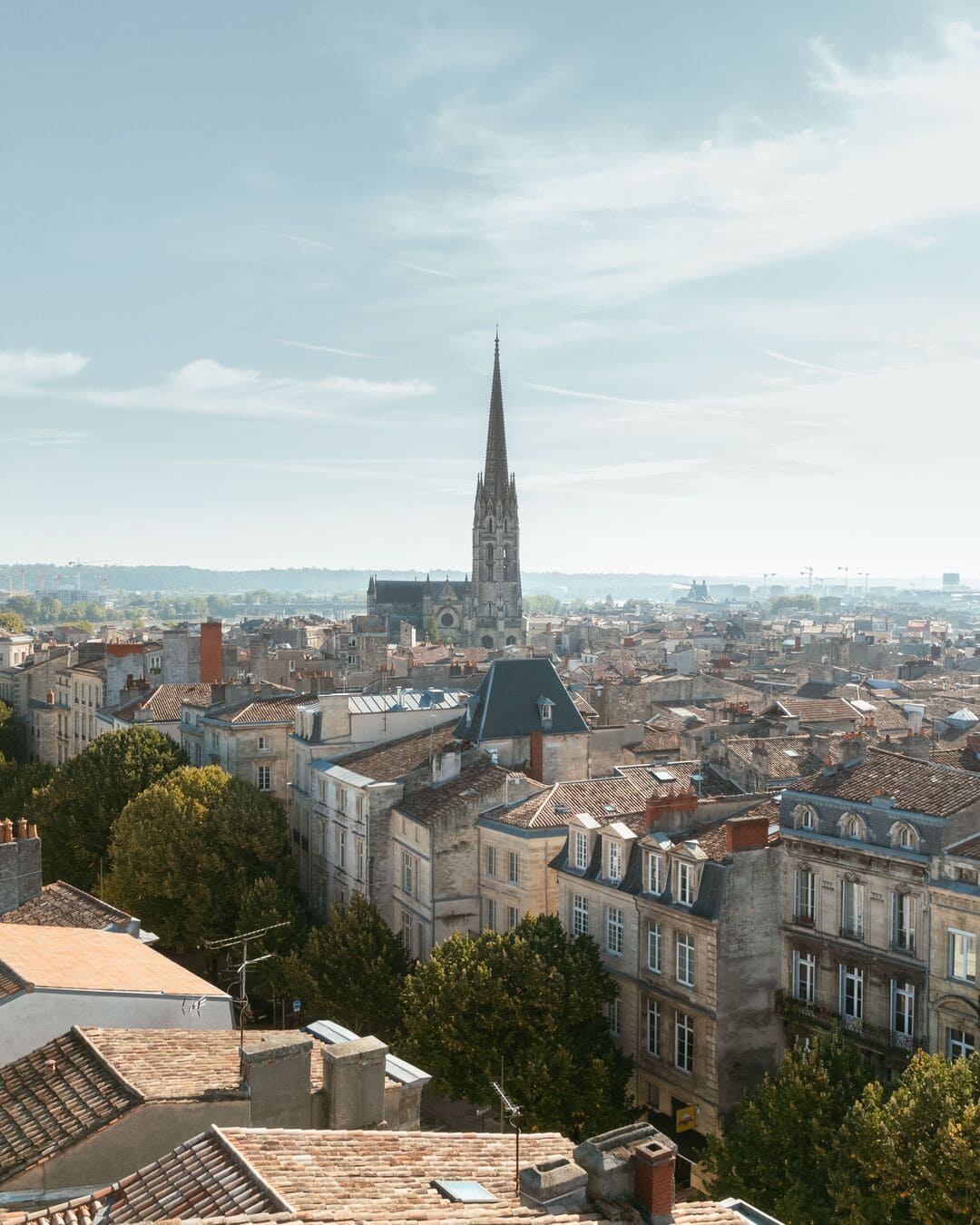
Few buildings in Bordeaux have a biography that reads like a picaresque novel. Utopia is one of them. This art-house cinema, which currently screens Bulgarian documentaries and Iranian films on Place Camille-Jullian, hasn't always been a dark projection room. It was first a 13th-century church, before turning, in succession, into a naval school for poor children (yes, with a real ship inside the nave), a sardine cannery, a bicycle shop, a car garage fitted with a mechanical elevator, and finally a cinema. Seven lives, one single building. A chronicle of permanent reinvention.
Life 1: Saint-Siméon church (13th to 18th century)
The building was erected at the end of the 13th century as the Saint-Siméon church. Gothic stone nave, five chapels, several religious brotherhoods attached to it. It also served as a parish cemetery until 1489, before the neighbourhood grew too crowded to keep burying the dead on site. For five centuries, the church played its quiet role as a local parish church, without a famous story or a famous figure, in the shadow of the great Bordeaux basilicas. It went through the Wars of Religion, the Fronde and the Ancien Régime. Then came the French Revolution.
Life 2: a naval school for poor kids, with a frigate inside the nave (1833)
After the Revolution, the church was deconsecrated, briefly turned into a saltpetre workshop, then left empty. In 1833, plot twist: the Laporte brothers, both naval officers, bought the building to open the École navale des mousses et novices, a philanthropic school meant to train poor, orphaned or abandoned children in seamanship, giving them a way out of poverty. The most delightful detail: the Laporte brothers installed a full-scale replica frigate in the middle of the nave, complete with masts, ropes and sails, for practical training. The kids learned to climb the rigging under a Gothic vault. The school ran for twenty years before moving in 1854 to a real ship moored in the port of Bordeaux, deemed more pedagogically appropriate.
Lives 3 to 6: sardines, bikes and cars (1863 to 1998)
From 1863 on, the reinvention took a much more industrial turn. Teyssonneau, a local industrialist, set up a sardine and vegetable cannery inside the building. The smell of incense gave way to the smell of fish oil. The stained-glass windows watched crates of tinned food roll by. That lasted a few decades before the factory shut down. The building then became a bicycle shop, a typical early-20th-century business in the Saint-Pierre commercial district. Then, more surprisingly, a car garage fitted with a mechanical elevator to hoist vehicles across several floors. Hard to picture what it looked like: a Peugeot 202 raised vertically under a 13th-century Gothic vault, but that is what happened for several decades. The building survived everything: two world wars, mass car ownership, rural exodus, the decline of the old city centre.
Life 7: Utopia cinema (since 1999)
In 1999, the Cinémas Indépendants Utopia association (an art-house network born in Avignon in the 1970s, with sister venues in Toulouse, Montpellier, Tournefeuille and Saint-Ouen-l'Aumône) bought the building and launched an unusual renovation. The bet: keep all the original ecclesiastical architecture, hide nothing, and fit five screening rooms into the medieval walls. The result is called simply Utopia, and today counts 555 seats under stone vaults. Stained-glass windows filter light into the circulation spaces, Gothic columns frame the entrances to the theatres, the natural acoustics of the nave add unexpected depth to dialogue. A bar-restaurant occupies the former side chapel. You have a drink under a 13th-century vault before watching a subtitled Iranian film. The editorial line is uncompromising: art house, auteur films, documentaries, filmmaker Q&As, debates. Not a single Hollywood blockbuster on the programme. The full story of the architectural conversion (room by room, with photos) is told in our dedicated Utopia article.
Why it sticks
What makes Utopia unusual isn't just the idea of a cinema inside a church (it exists elsewhere). It's the full chain of reinventions: monks, cabin boys, sardines, bikes, cars, film buffs. Seven completely contradictory uses in the same architectural volume, over seven centuries. Bordeaux has rarely produced such a demonstration of urban resilience. For more stories in the same vein, see our panorama of 5 places hiding another life, and our article on the Bassins de Lumières, that other Bordeaux venue that changed its script mid-way. Address: 5 place Camille-Jullian, 33000 Bordeaux. Programme available in the Gazette Utopia, free at the entrance.