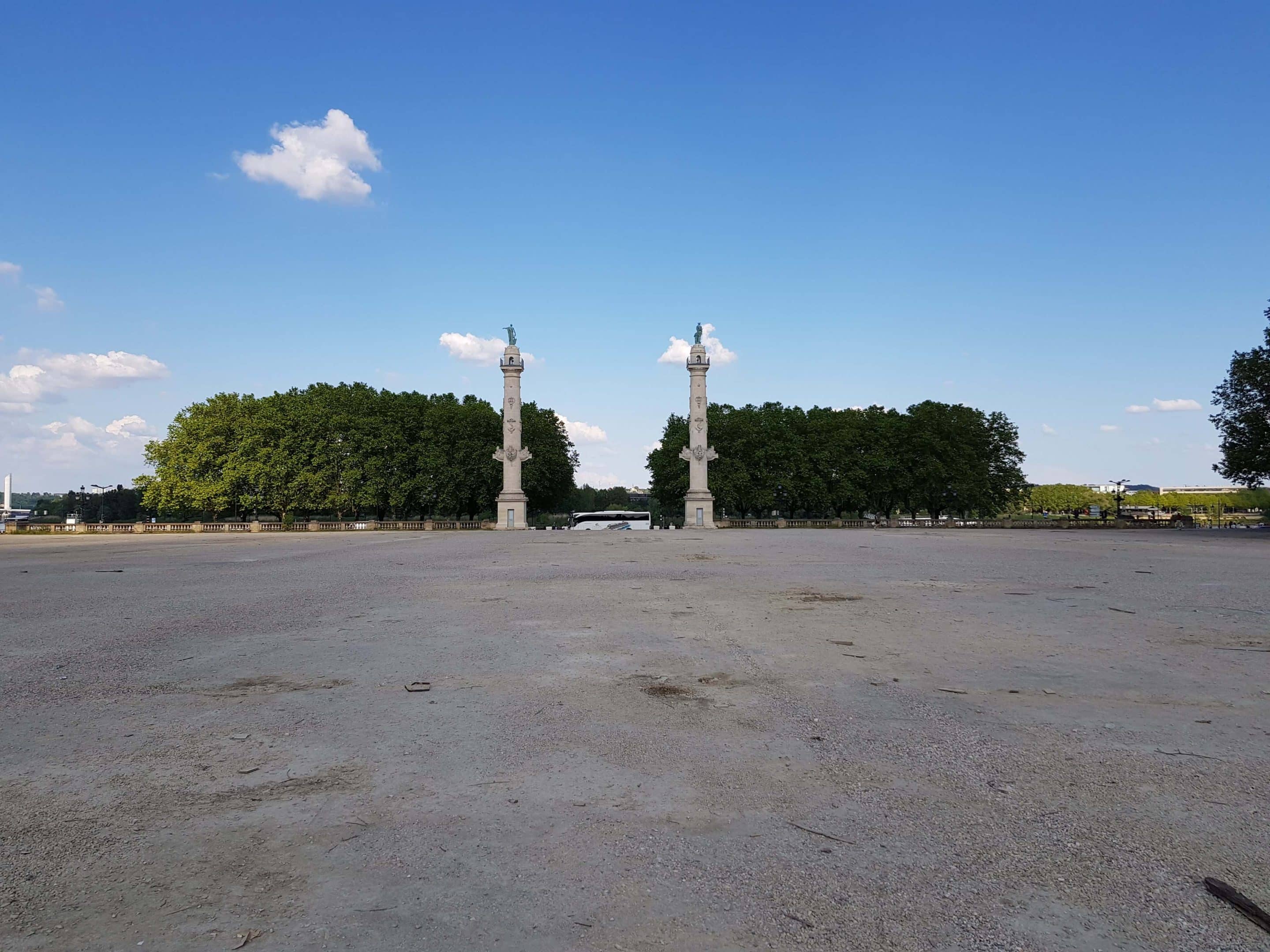
You walk across it every day without really looking at it. Yet, beneath its 126,000 sq m of gravel, lawns and pathways, Place des Quinconces holds five centuries of Bordeaux history, sometimes turbulent, often unexpected. A hated fortress, a royal square, a famous sculptor's project scrapped over budget, a tribute to the martyrs of the Terror, and even a German bunker hidden beneath the esplanade: here is everything the largest square in France, and one of the biggest in Europe, keeps out of sight.
Before Quinconces, there was Château Trompette
To understand why this square is so vast, we have to go back to 1453. That year, at the end of the Hundred Years' War, King Charles VII took Bordeaux back from the English, after several centuries of Plantagenet rule. Bordelais residents had grown used to their English masters and did not exactly welcome the French as liberators. Charles VII's answer was immediate: to crush any hint of revolt, he ordered a massive fortress to be built on the banks of the Garonne, Château Trompette.
For more than three centuries, this fortress embodied royal power at the heart of the city. Vauban modernised it under Louis XIV at the end of the 17th century, turning it into one of the mightiest strongholds of the kingdom, able to fire on the harbour as well as on the city itself. The message was clear: any Bordelais tempted by insubordination would be in the line of fire. Needless to say, the fortress was not exactly popular. When the Revolution came, its demolition became one of the symbolic acts Bordeaux residents had waited for the most. It was gradually torn down from 1818 onwards, freeing up a huge riverside plot. That plot is today's Place des Quinconces.
12.6 hectares planted in a quincunx pattern: the sheer scale and the origin of the name
With its 126,000 sq m, roughly 12.6 hectares, Place des Quinconces is one of the largest squares in Europe. For comparison, it is five times the size of Place de la Concorde in Paris, and much bigger than Saint Peter's Square in Rome. That scale is no accident: by demolishing Château Trompette, the authorities of the early 19th century wanted to mark a clean break with the Ancien Régime, and to offer Bordeaux residents a large open space overlooking the Garonne.
The name comes directly from the way the trees were planted. A quincunx is a layout inherited from Roman antiquity, where trees are planted in staggered rows: four trees at the corners of a square, a fifth in the middle, exactly like the number 5 on a dice. This layout saves space, lets light pass between the rows, and creates visual perspectives from any angle. From 1818, the square's first lime trees were planted according to this scheme, and the name stuck, even though the greenery has since been replaced several times.
The Girondins monument (and the Bartholdi we let slip away to Lyon)
At the centre of the square stands the unmissable Girondins monument, unveiled in 1902 after more than fifteen years of works. This 43-metre column, topped with a statue of Liberty breaking her chains, honours the Girondin deputies guillotined during the Terror in 1793. These Bordeaux politicians, moderates but opponents of Robespierre, had been swept away by the most radical revolutionary currents. The monument, which combines the column and two large bronze fountains, symbolically celebrates the Triumph of the Republic (Grand Théâtre side) and the Triumph of Concord (Garonne side). A way of saying that the Republic always ends up triumphing, even after its worst excesses.
But here is the monument's best-kept secret: it could have been the work of an infinitely more famous sculptor. Frédéric Auguste Bartholdi, creator of the Statue of Liberty in New York, had submitted his own monumental fountain project for Quinconces. The city council found the project too expensive and eventually rejected it. Bartholdi never got over it and offered his project to another city: Lyon, which accepted it and unveiled it in 1892 on Place des Terreaux. It is now one of the most famous fountains in the Rhône city, and one of Bordeaux heritage's great "what could have been." The monument that was finally built was designed by sculptor Achille Dumilâtre, magnificent in its own way, but with a little less New York sparkle.
Also worth noting on the square: the two rostral columns unveiled as early as 1829, honouring trade and navigation, and the statues of Montaigne and Montesquieu, two Bordeaux philosophers symbolically standing guard. A rare concentration of republican and humanist symbols for France.
Under the tarmac: an 83 sq m German bunker forgotten since 1943
This is probably the least known secret of the square. A few metres below the esplanade lies a reinforced concrete bunker of 83 sq m, built in 1943 by the German army during the Occupation. Its mission: to protect the military communications of the garrison that then occupied Bordeaux, a highly strategic city thanks to its port and its submarine base. The Quinconces bunker was part of a wider defensive network, several remnants of which still exist today in Bordeaux's underground, forgotten by the public.
Today, this bunker is no longer accessible. It has been walled up, covered over, absorbed into the urban underground like a sealed time capsule. But it is still there, a few metres beneath the feet of walkers, protesters and skateboarders who take over the square all year round. To dig deeper, we covered this topic in our article on the bunkers under our feet, which lists all the Second World War military structures still present in Bordeaux's underground.
A square that sums up Bordeaux
Royal fortress, revolutionary square, republican tribute, aborted artistic project, buried wartime relic: Place des Quinconces on its own concentrates five centuries of Bordeaux history. It is a square that does not reveal itself at first glance, but it rewards those who take the time to scratch beneath the surface. Next time you walk across it, look up at the statue of Liberty on the Girondins monument, spot the trees planted in the quincunx pattern, and picture, a few metres below, a forgotten bunker silently watching over the city's memory.