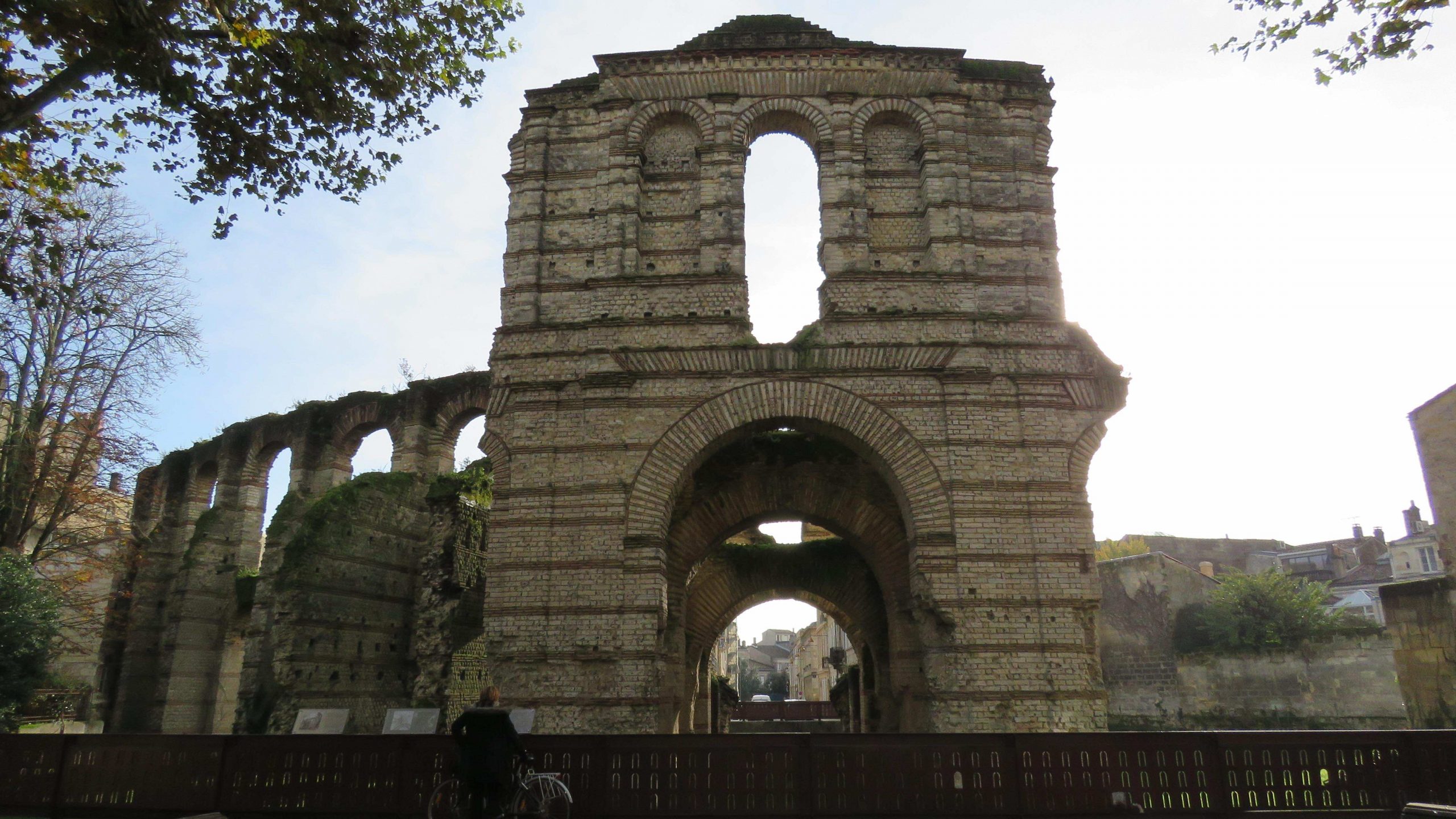
Some things you walk past every day without noticing. The Palais Gallien is one of them. You walk down the rue du Docteur-Albert-Barraud in the Fondaudège neighbourhood, past perfectly ordinary Haussmann-style buildings, and suddenly, between two façades, a row of Roman stone arches rises 22 metres above the street. These are the only visible remains of Gallo-Roman Bordeaux. An amphitheatre built at the very beginning of the 3rd century AD, sitting today in the middle of an ordinary residential district as if the city had simply forgotten to notice it. Absolutely surreal.
An amphitheatre for 20,000 people
In Roman times, Bordeaux was called Burdigala. It was an important provincial capital, prosperous thanks to the wine trade and its position on the Garonne. At the very start of the 3rd century, under emperor Septimius Severus, the city built itself a monumental amphitheatre. Not a modest provincial arena: an ellipse 132 metres long and 111 metres wide, seating up to 20,000 spectators on three tiers. For scale, the current Grand Théâtre of Bordeaux seats about 1,000 people, the Roman amphitheatre of Nîmes holds 24,000, that of Arles 20,000. Bordeaux was playing in the top league. Gladiator fights, hunts of exotic beasts imported from North Africa, public executions and great imperial spectacles were all staged there. A Chaban-Delmas stadium of Antiquity, right in the city centre.
How it almost entirely disappeared
After the fall of Rome and the barbarian invasions, the amphitheatre lost its purpose. Too big, too expensive to maintain, it was gradually abandoned. In the Middle Ages, it served in turn as a fortified refuge, a cemetery, a rubbish dump, and above all an open-air quarry. For more than a thousand years, Bordeaux residents came to pick out the dressed stones for their own houses, their churches, their city walls. The tiers vanished block by block. What remains today is a portion of the outer arcades, the ones that couldn't easily be dismantled without collapsing the whole. What you see today, a few arches over roughly 60 metres, probably represents around 5% of the original building. The rest is scattered inside the walls of the city. It's very likely that your favourite terrace is sitting on a few stones that, 1,800 years ago, watched gladiators fight.
Why it's called "Palais Gallien"
Amusing curiosity: the name is completely wrong. No palace ever existed there, and emperor Gallienus (reigned 253-268) had nothing to do with the building. The explanation is medieval. In the 12th century, when Eleanor of Aquitaine ruled Bordeaux, a popular legend circulated: the queen was said to have met a lover in the ruins of the amphitheatre. No one dared accuse the sovereign directly, but people love a story. Rather than name Eleanor, they invented an ancient queen, Galliena, imaginary wife of a legendary emperor, and named the ruins "Palais Galliena", then "Palais Gallien". The name stuck, with no historical basis. Extra twist: the real ancient name of the monument is lost. We don't know what the Romans themselves called their amphitheatre.
Rediscovery and visit today
For a long time, nobody paid attention to the site. In the 18th and 19th centuries, Bordeaux authorities even considered fully demolishing the remains to straighten the streets. Only in the 1830s did the prefect finally classify the monument, saving what was left. Today, the Palais Gallien is a listed Monument Historique, owned by the City of Bordeaux, open to visitors from June to September (free access during some periods, paid guided tours). The rest of the year, you can walk around and admire it from the street, where it emerges from the façades like a set-piece from an old film. It's probably the most striking Roman ruin still visible in a French city centre, so completely does its scale contrast with the surrounding residential fabric. For more Bordeaux stories where history refuses to disappear, see our panorama of 5 places hiding another life, our article on the Bassins de Lumières, or our Secrets of Bordeaux series.
How to get there
Address: 126 rue du Docteur-Albert-Barraud, 33000 Bordeaux (Fondaudège district). 10 minutes on foot from the Quinconces, or by tram (line C or D, Jardin Public stop then 5 minutes on foot). Best combined with a walk in the nearby Jardin Public for a morning of nature and Antiquity.