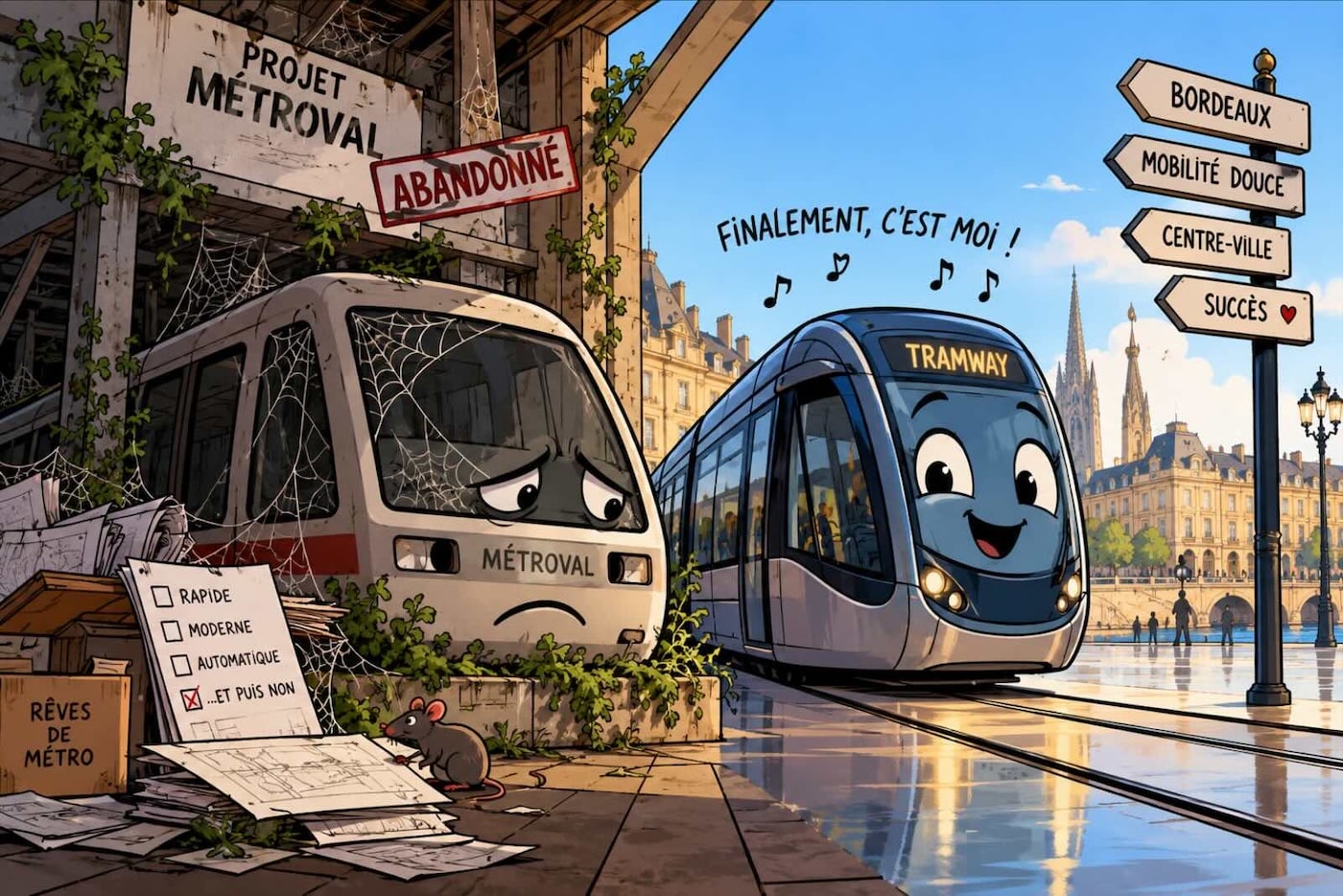
Picture it for a moment. You ride an escalator down beneath the Place des Quinconces, a driverless train glides in on its rubber tyres, the platform doors slide open, and a few minutes later you step out at Saint-Jean station without having glimpsed the Garonne or a single honey-coloured stone façade. This underground Bordeaux very nearly existed. For almost ten years the city prepared its automated metro, the VAL, complete with maps, stations, votes and millions already spent. Then everything stopped. And it was out of that abandonment that the tram now running across the metropolis was born.
A major city with no tram and no metro
Think back to the Bordeaux of the 1980s. The historic tramway had vanished in 1958, sacrificed, as in so many cities, to cars and buses. The quays were one long car park lined with warehouses, residents were drifting out to the suburbs, and traffic jams set in every morning and evening. Bordeaux was one of the few large French cities with neither a metro nor a tram. Lyon, Marseille and Lille had dug theirs or were about to. Bordeaux travelled by bus.
The model that local leaders dreamed of was the VAL, short for véhicule automatique léger, or light automated vehicle. A small driverless metro on rubber tyres, designed by Matra and launched in Lille in 1983. Fast, frequent and modern, it embodied progress. Jacques Chaban-Delmas, mayor of Bordeaux since 1947 and president of the Urban Community, made it the great project of the final years of his long reign.
1986: a Y-shaped metro
On 27 June 1986, the Bordeaux Urban Community unanimously approved the preliminary design. The first route drew a Y: a line would leave Saint-Jean station, head up towards the city centre and split at the Quinconces. One branch would run to Mériadeck and Pellegrin hospital, the other to the Grand Parc and the Lac district. Extensions to Mérignac, the exhibition centre and Lormont were discussed but never really worked out. In the long run, the dream network was to reach 45 kilometres.
Very quickly, though, the project ran into a criticism that would dog it to the end. In 1989, a study by SOFRETU, the engineering arm of the Paris transport authority RATP, found that the route did not match real needs: in particular, it ignored the Talence-Pessac university campus, one of the biggest generators of journeys in the whole area. Critics said Bordeaux's metro would serve the hypercentre, while the traffic jams came from the suburbs.
Lines A and B that never existed
The project was revised in 1990, and on 6 November 1992 the Urban Community voted to build it. The first phase included two lines. Line A was to link Saint-Jean station to Raversies, in Le Bouscat, over 6.7 kilometres and ten stations. Line B was to run from Thiers-Galin, on the right bank, to Pellegrin hospital, over 6.4 kilometres and nine stations. A line C even appeared on the plans.
A nice twist of history: the letters A and B, and some of those destinations, would turn up ten years later on the map... of the tramway.
A bill that kept climbing
The real problem was money. Estimated at 3.8 billion francs in 1990, the cost of the VAL had climbed to 6.4 billion by 1994. Tunnelling under Bordeaux is no easy task: the city stands on uneven ground, sand, clay and waterlogged alluvium, right next to a tidal river. Every kilometre of tunnel comes at a steep price.
Standing against the project was a users' association that fought relentlessly: Trans'Cub. Its campaigners kept repeating the same argument, and it hit home: for the price of one kilometre of metro, you can build ten kilometres of tramway. With the same budget, they argued, the whole area could be served instead of a handful of central stations. Part of the opposition, and even some councillors from the ruling majority, were eventually won over.
1994, the year everything changed
In January 1994 came a bombshell: acting on a challenge from opponents, the Conseil d'État, France's highest administrative court, struck down the declaration of public utility. The project was scaled back once more and narrowly reaffirmed by the Urban Community. The State even announced 400 million francs in support. But the momentum was gone.
On 22 July 1994, the councillors had to approve the concession agreement, the contract for building and operating the metro. The vote was decisive: 64 against, 54 in favour, 2 abstentions. The Bordeaux VAL died in the council chamber, after a decade of studies estimated to have cost some 250 million francs.
Juppé arrives, the tram returns
In June 1995, Jacques Chaban-Delmas stepped down after nearly half a century as mayor. Alain Juppé succeeded him and took over the Urban Community in July. He buried the metro for good and chose the option championed by his former opponents: bringing back the tramway. The project was launched in 1996 and declared of public utility in 2000.
One puzzle remained, one the VAL had dodged by going underground: how do you run a tram through a listed city centre without planting poles and overhead wires in front of the Place de la Bourse or the Grand Théâtre? The answer was a world first, ground-level power supply, which we tell you about in our article on Bordeaux's wire-free tram. The first line opened on 21 December 2003. With it, the quays were handed back to pedestrians, façades were cleaned, and Bordeaux woke up. The city long nicknamed the sleeping beauty owes much of its awakening to the metro it never had.
The ghost that returns at every election
Ghosts never really die. The Bordeaux metro resurfaces in public debate every time the trams are packed at rush hour. In 2019, a study commissioned by Bordeaux Métropole judged a line to be worthwhile. The idea was shelved again during the 2020 municipal campaign. In 2021, an association called Métro de Bordeaux proposed a 19.3-kilometre line with 18 stations. And in 2025, a new study concluded that a light automated metro would be technically feasible, but at an estimated cost of around 2.7 billion euros, with an unfavourable cost-benefit assessment.
Thirty years after the 1994 vote, the debate has hardly changed: a fast metro for some, or surface transport for all. Like the transporter bridge that was never finished over the Garonne, the VAL belongs to the parallel Bordeaux that might have been. Next time you are waiting for tram B in the rain, spare it a thought: had it not failed, you might be underground.
The Bordeaux metro: key dates
27 June 1986: VAL preliminary design unanimously approved by the Urban Community
6 November 1992: vote to build it (lines A and B, about 13 km in the first phase)
January 1994: the Conseil d'État strikes down the declaration of public utility
22 July 1994: concession agreement rejected, 64 votes to 54
1995: Alain Juppé drops the VAL for good in favour of the tramway
21 December 2003: the first tram line opens