Lis cet article en français : Le marché des Capucins.
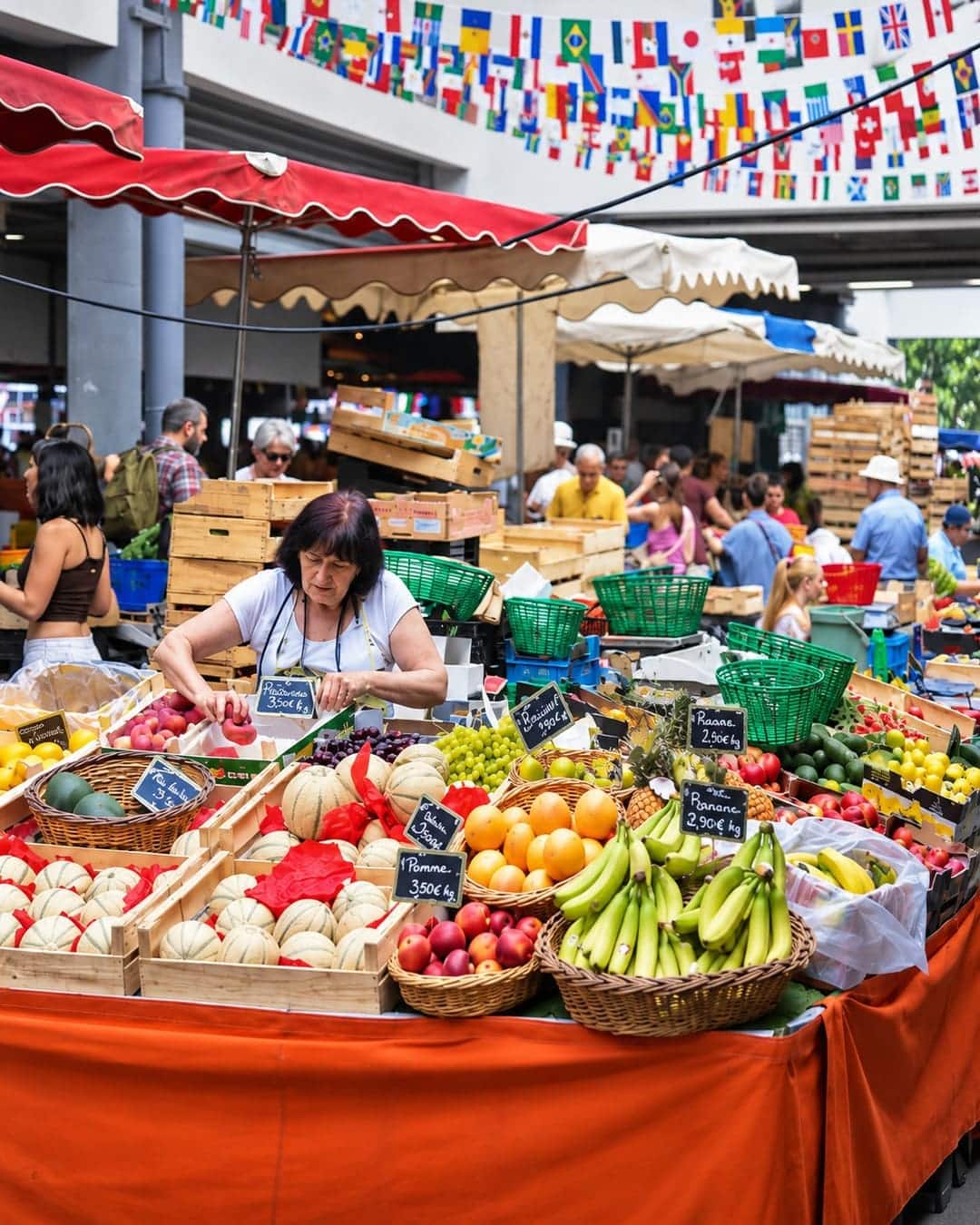
Everyone will tell you to go. Nobody will tell you when, which day, or what to do once you are under the hall. The Marché des Capucins is Bordeaux's largest covered market, more than 80 stallholders, a history that starts in 1749, and an oyster-at-the-counter ritual locals have been practising for generations. It is also a place where you can miss the mark completely if you show up on a Monday, or at 1:30 pm on a Tuesday. Here is the full user manual, official hours checked and confirmed.
The essentials at a glance
The Marché des Capucins sits on place des Capucins, in the Saint-Michel district in Bordeaux. The hall is open Tuesday to Friday from 6 am to 1 pm, and Saturday and Sunday from 6 am to 2 pm. It is closed on Monday.
That is the rule to keep in mind before anything else. On Monday you will find the doors shut, and that is the number one visitor mistake.
These hours are the ones published by the City of Bordeaux, which oversees municipal markets and describes the Capucins as the city's largest market. A useful detail: the market's own website shows slightly different weekday closing times. In practice, it does not change much, because stalls start packing up well before the official time. Concrete translation: do not plan to arrive at 12:45 pm hoping to shop quietly.
Do you know why it is called the belly of Bordeaux?
The nickname dates from the late 19th century and was earned stall by stall.
The name of the place itself comes from the Capuchin friars, mendicant brothers attached to the Order of Saint Francis, recognisable by their brown robe ending in a capuce, a kind of pointed hood. They settled in the area and gradually turned a neighbourhood with a bad reputation into a space of gardens and terraces. The square kept their name.
The first weekly market was born on 2 October 1749, driven by the Marquis de Tourny, the intendant who redrew Bordeaux in the 18th century and to whom the city also owes its allées. In 1797, after the Revolution, a livestock market officially settled on the square. Weekly at first, it became daily.
The neighbourhood then turned into a real food hub. Herbalists, shoemakers, roofers, carpenters, blacksmiths and drapers set up around it. Market gardeners from the surrounding area rolled in with their carts: artichokes from Macau, potatoes and watercress from Eysines, tomatoes and fruit from Gradignan. That is where the venue's popular identity comes from, and it has never left.
From 1857, the Capucins became Bordeaux's leading market, with the introduction of auction sales to organise trade. In 1863, the city launched a covered-halls project. After the Paris Universal Exhibition of 1878, the municipality reused metal structures to build two pavilions on either side of the square. In 1881, the two buildings were linked by a large iron and glass gallery, under which horse-drawn omnibuses still ran. The architecture drew directly on Baltard's halls.
Between the late 19th century and the 1970s, the market became far more than a shopping venue. A place to meet, to talk, to live. The nickname of the belly of Bordeaux came on its own.
Then came the dip. From the late 1960s, supermarkets changed habits and the activity declined despite modernisation efforts. It took a heavy 1999 renovation for the market to bounce back: hall A was completely renovated, a large central aisle under a glass roof was recreated, new commercial islands were installed, and the water, electricity and cold-storage supply were upgraded. That is the market we know today.
What you really find under the hall
More than 80 stallholders, and a layout that reads quickly once you have grasped the logic.


Fishmongers and oyster stalls hold the centre, that is the house specialty. You will find oysters from the Arcachon Bay, shellfish and crustaceans landed the same morning. Chez Jean-Mi, oysters and seafood, is one of the market's most recognisable names.
Butchers and charcutiers are many, with several long-standing houses, including the Boucherie Gautier and the Boucherie Charcuterie Volailles Gazeau. On fruit and vegetables, Ambre Primeurs and Prunelle work the stalls. La Ronde des Fromages covers the cheese counter, Boulangerie Amandine handles bread and pastries, and La Cave des Capucins looks after the wine.
The market also has its share of specialities that reach beyond the Aquitaine terroir, with names such as La Maison du Pata Negra, O'Billig, L'Ostal, La Cabane de Guillaume, La Guitoune or Ferme du Vignal. And bistros settled under the hall, like Bistro Poulette, which live side by side with the stalls without anyone seeing a contradiction.
The full stallholders directory is published on the market's website, and it moves: that is the reflex to have if you come looking for a specific producer.
That coexistence is what makes the place: you can do your weekly shop here, or simply sit down and eat.
The oysters-at-the-counter ritual
It is the reason many Bordeaux locals go, and it is not just another dining option. It is a social practice.
The idea is simple. You settle at an oyster counter, standing or on a stool, order a dozen Bay oysters shucked in front of you, and a glass of Sud-Ouest white. You eat elbow to elbow with your neighbour, in the noise, without a booking and without ceremony. It happens in the morning, not in the evening. And it happens especially at the weekend.
A few reflexes that make a difference. Take the wine at the counter rather than from outside, it is the same move and it is part of the decor. Do not look for a quiet table, there is none and that is not the point. And if you want to keep going, the charcutiers and cheesemongers are a few metres away: a slice of ham, a piece of cheese, and you have built your lunch without leaving the hall.
If the topic interests you beyond the counter, we went to see what oyster farming looks like on the Bay side in our visit to the Nami oyster beds and oyster table in Andernos.
What time to come?
The hall opens at 6 am. That is very early: at that time, the pros and the regulars are the ones inside.
For shopping, aim between 8 and 10 am. Stalls are full, produce has not been rummaged, and you can still speak to the traders without queueing.
For the atmosphere, come between 10 and 11:30 am on Saturday or Sunday. That is when the hall is full, when the oyster counters are running at full speed and when the buzz peaks. It is also the moment when you will not find a seat, so come knowing you will stay on your feet.
The last hour is packing up. On weekdays, the official closing is 1 pm, so everything empties out from noon. At the weekend, you gain an hour, the hall closing at 2 pm. In both cases, some stalls slash prices at the end of service, which can be a good deal if you know exactly what you are looking for, but the choice has collapsed and the atmosphere has dropped.
The general rule: stallholders close before the official time, never after.
One last practical point: on a rainy day, a covered market completely changes status. It is one of the best Bordeaux ideas when it rains, and we listed others in our Bordeaux in the rain guide.
On Monday, when the Capucins are closed
That is the information nobody tells you, and yet it is the one that saves a morning.
On Monday, the Capucins hall is closed. But the Saint-Michel district does not sleep. The Marché Neuf, on quai des Salinières, takes over on that very day, from 7 am to 2 pm. It is not the same experience, but it is open, and it is a ten-minute walk away.
Across the rest of the week, the area is one of Bordeaux's densest for markets:
- Halle du marché des Capucins, place des Capucins: Tuesday to Friday 6 am-1 pm, Saturday and Sunday 6 am-2 pm
- Marché Neuf, quai des Salinières: Monday 7 am-2 pm
- Marché Royal Saint-Michel: Saturday 7 am-2 pm
- Sunday flea market, place Canteloup: Sunday 7 am-2 pm
- Second-hand flea market: Tuesdays and Thursdays 7 am-2 pm
- Bouquinistes de la Victoire: Thursdays and Fridays 8 am-5 pm
In other words, there is something to browse or buy every day of the week, a few hundred metres from each other. The most effective combo remains Sunday morning: the Capucins for oysters, then the Canteloup flea market right behind the Saint-Michel basilica. We laid out that sequence hour by hour in our perfect Sunday morning in Bordeaux.
How to get there
The simplest way remains the tram. Line B, Victoire stop, drops you a good five minutes on foot from the square. That is the most direct access from the city centre.
On foot, if you arrive by train, count about fifteen minutes from Gare Saint-Jean up the cours de la Marne, which opens right by the square. And if you come from the neighbourhood, the Saint-Michel basilica is five minutes away, its spire serving as a landmark from a distance.
By car, a car park sits directly above the hall, with access ramps and lifts. It is handy, but on Saturday morning the neighbourhood is saturated: the tram stays the right call on that day.
By bike, self-service bike stations are set up nearby. For bus lines and real-time timetables, the Bordeaux Métropole Transports website is the only source kept up to date, as line numbers change regularly.
The hall is on one level, which makes it easy to reach, but peak-hour crowding makes moving around tricky in a wheelchair or with a stroller. The morning slot is a lot more comfortable.
Frequently asked questions
Is the Marché des Capucins open on Monday?
No. The hall is closed on Monday. It is open Tuesday to Friday from 6 am to 1 pm, and Saturday and Sunday from 6 am to 2 pm. On Monday, the Marché Neuf on quai des Salinières takes over from 7 am to 2 pm.
Can you eat on site at the Capucins?
Yes. Several oyster stalls and bistros under the hall serve on site, at the counter. It is even one of the main reasons to go, in particular for Arcachon Bay oysters paired with a glass of white wine.
What is the best time to go?
Between 8 and 10 am to shop quietly with the best choice. Between 10 and 11:30 am on Saturday or Sunday for the atmosphere, even if you have to stay on your feet.
Is the Marché des Capucins free?
Yes, access to the hall is open and free. You only pay for what you eat or buy.
Why is it called the belly of Bordeaux?
The nickname dates back to the late 19th century, when the market became the city's main supply point and a place of daily life in its own right, well beyond simple food shopping.
Practical info
- Address: place des Capucins, 33800 Bordeaux, Saint-Michel district
- Hours: Tuesday to Friday 6 am-1 pm, Saturday and Sunday 6 am-2 pm
- Closed: Monday
- Access: tram B, Victoire stop, then 5 minutes on foot. About fifteen minutes on foot from Gare Saint-Jean
- Car: car park located above the hall, avoid on Saturday morning
- Accessibility: hall on one level, heavy footfall late morning
- Budget: free access, the price of a dozen oysters with a glass of white remains one of the best pleasure-price ratios in Bordeaux
- Best slot: 8-10 am to shop, 10-11:30 am at the weekend for the atmosphere
To go further
- Official hours of municipal markets are published and kept up to date by the City of Bordeaux on bordeaux.fr
- The market's website, marchedescapucins.com, lists the stallholders directory and the venue's detailed history
- For real-time public transport access, infotbm.com
- On the neighbourhood around it, read our Saint-Michel portrait in the unfiltered ranking of Bordeaux neighbourhoods