
Some museums in Bordeaux tell you as many stories through their walls as through their collections. The madd-bordeaux, the Museum of Decorative Arts and Design, is one of them, but it goes even further: in a single visit it walks you through an 18th-century private mansion, a 19th-century prison, and finally into cutting-edge contemporary design. And since 22 April 2026, it has just reopened its doors after three years of works.
Let's be clear right away: it looks like no other museum in the city. Here is why it deserves the very top of your list, somewhere between must-see and hidden gem.
A private mansion built in 1778… for a wealthy parliamentarian
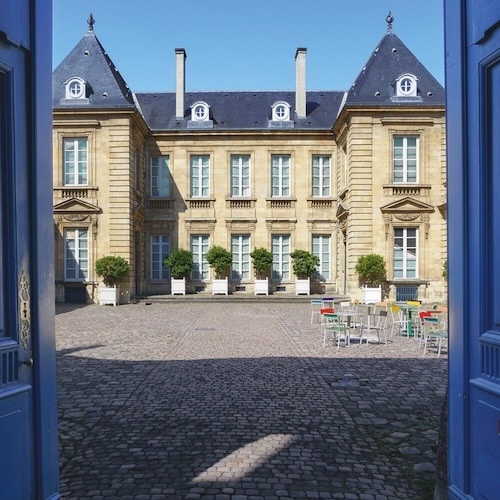
The historic heart of the museum is the Hôtel de Lalande. It was built in 1778 by Bordeaux architect Étienne Laclotte for Pierre de Raymond de Lalande, a member of the parliament of Bordeaux and one of the great fortunes of the city. Back then, Bordeaux parliamentarians had mansions built to display their rank, and this one was quickly regarded as one of the most beautiful private houses in the city.
The catch is that the mansion only stayed in the family for a few decades. As early as 1828, the heirs sold it, and the building changed hands several times through the 19th century. Until 1880, when the City of Bordeaux bought it back. But the city did not buy it to turn it into a museum: it moved its police services and its vice squad in. Yes, you read that right. One of the most beautiful mansions in Bordeaux became a police station.
1886: a prison quietly moves in at the back
This is where the story gets really juicy. In 1886, the city built a jail on the site of the mansion's former garden, backing on to the house itself: a prison. It came to complement the police services housed in the mansion, and would coexist with municipal activities for decades.
Meanwhile, in 1924, the city opened a Museum of Ancient Art on the ground floor of the Hôtel de Lalande. It would be renamed Museum of Decorative Arts in 1955, then Museum of Decorative Arts and Design in 2013, when contemporary design officially joined the programme. In between, in 1964, the police services left the building for good. The prison itself kept operating for a few more years, before being decommissioned.
From 1979 onwards, the former prison, with its corridors, cells and armoured doors, became a storage space: it housed the museum's reserves. It only opened to the public in 2017, for temporary exhibitions that would change everything. Bordeaux residents then discovered that behind the 18th-century salons stood a jail world that had remained almost intact. In 2018, both buildings, the mansion and the prison, were jointly listed as Historic Monuments. They also sit within the UNESCO perimeter of the Port de la Lune, a World Heritage site since 2007.
14 million euros and three years of works to make history and design talk to each other
In May 2023, the museum closed for a major overhaul. The project was awarded to Antoine Dufour Architectes, selected as early as 2019, and mobilised a total budget of 14.14 million euros excluding VAT, backed by the City of Bordeaux, the French state (Green Fund, DSIL, DRAC), the Nouvelle-Aquitaine Region, private sponsors and the European Union via the ERDF.
The goal was not just to refresh the paintwork. It was to completely reinvent the layout and uses, around a few key markers:
- full accessibility (100 % of the museum accessible, two new lifts installed),
- a 40 % cut in energy consumption, 100 % LED lighting,
- a strong commitment to reuse: 200 tonnes of materials reused, 85 % of them directly within the museum,
- turning the former prison into a genuine permanent exhibition space, with cells converted into rooms dedicated to contemporary design.
The effect is striking. You move from a Versailles parquet salon with gilded wood panelling from the 18th century into a cell with thick walls, its original metal door, the old locks carefully preserved… and inside you discover an iconic 20th-century chair or an object signed by a designer of today. This visual tension between prison constraint and creative freedom is what gives the madd-bordeaux its unique identity.
What reopens on 22 April 2026 (and what is still to come in 2027)
The reopening is happening in two phases, and it is worth knowing to plan your visit:
- since 22 April 2026: the Boulan wing is open, with reception, shop, restaurant, new exhibition spaces and, above all, the former prison fully accessible,
- during 2027: reopening of the mansion itself, with a brand-new museum route and the reception rooms brought back to life.
In other words, in April 2026 you can already experience the most spectacular part of the museum: visiting the former prison reinvented by design. And you will come back in 2027 to discover the restored salons. Two visits rather than one is not a flaw, it is an opportunity.
Practical info
- Address: 39 rue Bouffard, 33000 Bordeaux
- Official name: madd-bordeaux (Museum of Decorative Arts and Design)
- Status: partially reopened since 22 April 2026 (Boulan wing + former prison)
- Full reopening: during 2027 (restored Hôtel de Lalande)
- Listing: mansion and former prison jointly listed as Historic Monuments since 2018, within the UNESCO perimeter of the Port de la Lune
- Good to know: the restaurant and the shop are accessible from the entrance, handy for extending the visit