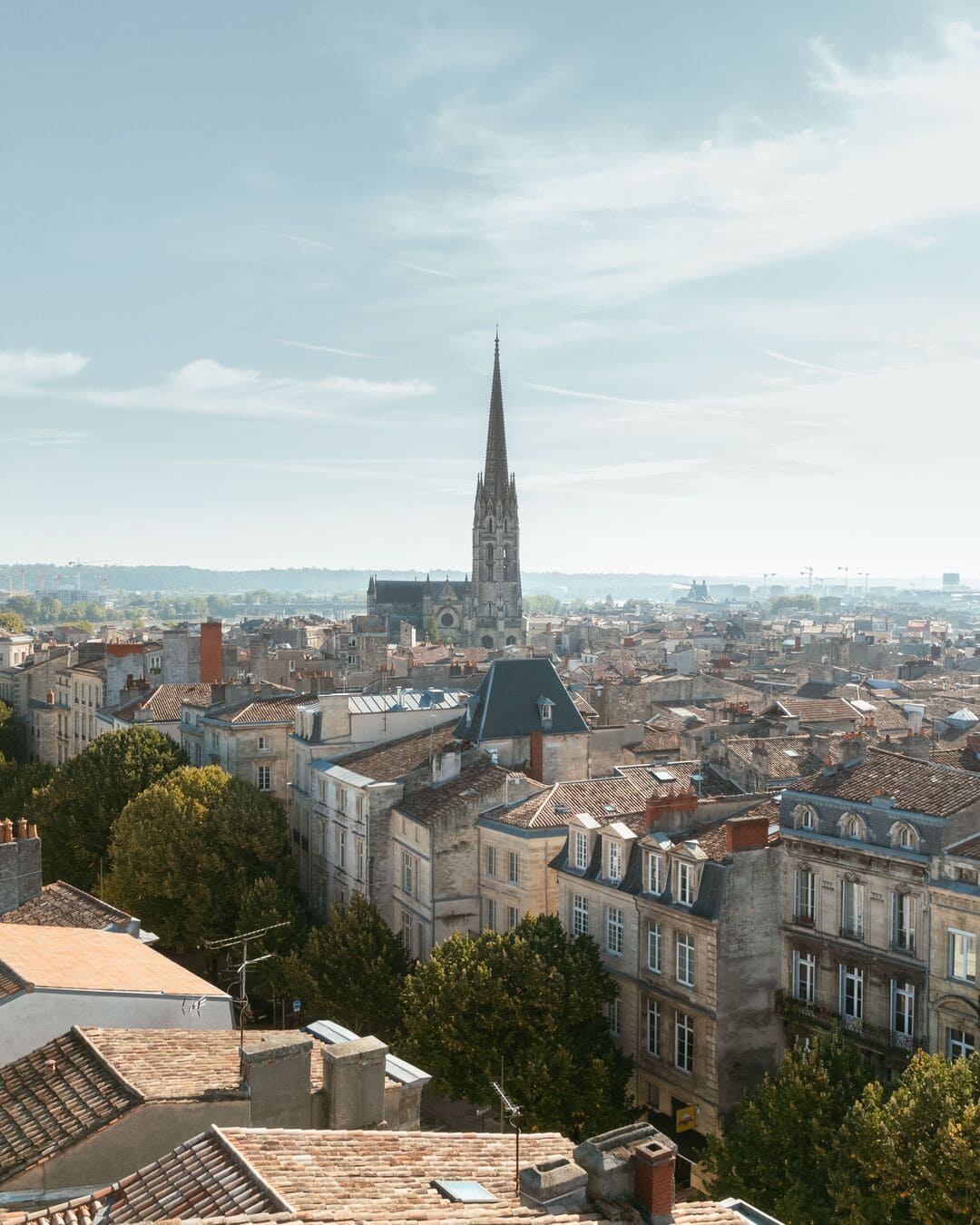
Not the Miroir d'eau or the Grosse Cloche. One of the most iconic monuments - and today the most photogenic - of the Bordeaux region is the Dune du Pilat. A living sand mountain, drawing millions of visitors each year and now ranking in France's top 10 most Instagrammed spots.
Between sky, ocean and pine forest, it's as much an experience as a setting. And that rare alchemy is doubtless what makes it endlessly fascinating.
The dizzying numbers of a living monument
Before climbing, a few numbers to gauge the scale:
- Height: between 101 and 111 meters (constantly changing).
- Width: 616 meters.
- Length: nearly 3 kilometers.
- Volume: 55 to 60 million m³ of sand.
- Age: over 4,000 years of geological history.
Located in La Teste-de-Buch, just 70 km south-west of Bordeaux, the Dune du Pilat stretches as a moving border between the Landes forest and the Atlantic Ocean.
How is a sand mountain born?
Its origin is a lesson in patience and natural persistence.
Two phenomena are behind it:
- The north-south drift carries sand along the Aquitaine coast.
- At the mouth of Arcachon Bay, this flow slows and causes massive accumulation.
The winds then tear grains from the Banc d'Arguin and drop them on the shore. Result: a dune inexorably moving inland, eating 1 to 5 meters of forest each year.
Under your feet, history is written in layers of sand and paleosols (ancient fossilized black soils).
Archaeologists have found traces going back to 3,500 BC - in some eras the dune was covered by forest, in others completely bare.
Between 1826 and 1922, it took its current shape while the coastline retreated by 500 meters. Bronze Age archaeological remains have even been found under its sands.
The sensory experience: a desert facing the Atlantic
The climb is a small challenge: barefoot, each step sinks, breath gets short. But once at the top, the view is unique.
- To the east: the dark green ocean of Landes pines, as far as the eye can see.
- To the west: the shifting vastness of the Atlantic.
- In between: you, suspended between two infinities.
Silence, wind, plays of light shifting hour by hour… The Dune du Pilat isn't just a setting: it's a sensory and contemplative experience.
An Instagram and TikTok star
Why do photographers and influencers love it?
- Its sea-forest contrast is unique.
- Light transforms sand and ocean throughout the day.
- The huge scale makes every shot spectacular.
Result: the Dune du Pilat racks up millions of shares on Instagram and TikTok, over 2.7 million yearly Google searches, and features in France's top 10 most Instagrammable spots.
Far more than a local monument, it has become a global visual icon.
The Dune isn't fixed: it advances inland, gradually swallowing the forest and human buildings.
It's a living, fragile monument, closely watched against erosion risks and climate change.
Education spaces like the IDune or nature activities raise visitor awareness about preserving this natural heritage.
Did you know that.... :
- The word « Pilat » comes from the Gascon pilhar, meaning pile or mound. Confusion with « Pyla » was born with the neighboring seaside resort, created in the 1920s.
- Bronze Age human remains have been found under the dune.
- In the evening, many like to run or roll down the slope: a descent as fast as the climb was laborious.
- Every season changes the scene: winter storms, spring mildness, flaming summer sunsets.
More than a tourist curiosity, the Dune du Pilat is a living sand mountain shifting with the winds, a true emblem of Arcachon Bay as unmissable as Bordeaux's historic monuments, and a postcard landscape captured by millions of visitors; so next time someone mentions the Miroir d'eau or the Grosse Cloche, remember that the region's true photogenic icon is still this giant dune uniting ocean, forest and sky in a breathtaking scene.