Bordeaux is one of those obvious places that sometimes takes time to click. A city of blond stone that long dragged around a slightly bourgeois image and has, over the past twenty years, completely reinvented itself. Today, you come for its UNESCO-listed monuments, but also for its buzzing neighbourhoods, its wine bars where winemakers and locals mingle, its markets that set the weekend tempo, its cultural scene playing its own tune, and this wide, magnetic river cutting through it all. This guide is your entry point: the essentials to see, taste and experience in Bordeaux, with links to our more detailed articles to dig deeper.
The UNESCO heart: the 18th-century facades you never tire of
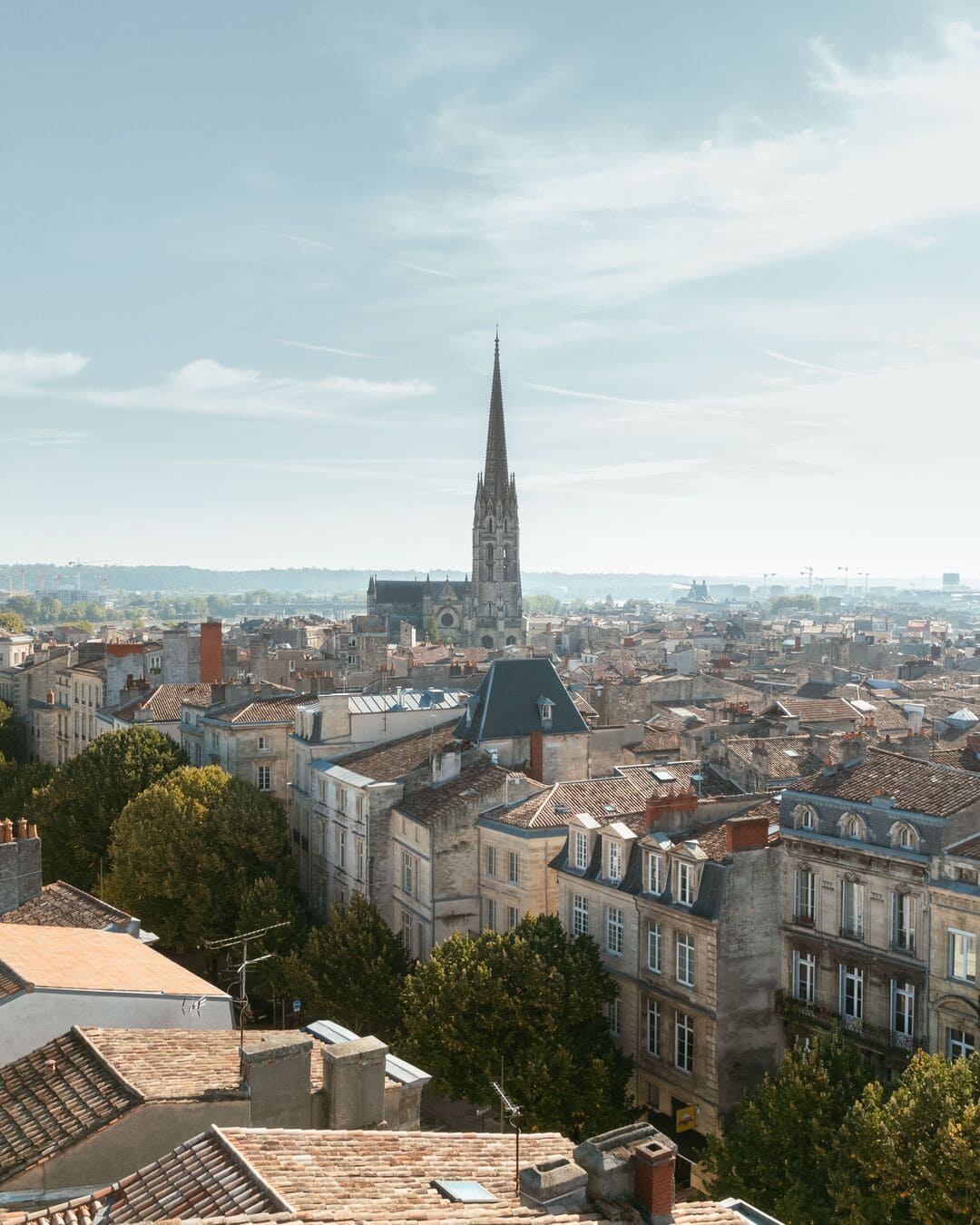
This is where everything starts. Place de la Bourse, designed by Ange-Jacques Gabriel between 1730 and 1755, offers one of the most beautiful neoclassical facades in Europe. Facing it, the water mirror, imagined by urban planner Michel Corajoud in 2006, casts its reflection in a 2-centimetre film of water that alternates between mirror and mist. Guaranteed effect, especially at dusk. A few minutes away on foot, Victor Louis' Grand Théâtre (1780) imposes its twelve-column peristyle, the Saint-André cathedral and the Pey-Berland tower raise their Gothic volumes, and the Cailhau gate plants its medieval silhouette at the entrance to old Bordeaux. Take time to look up: the city reads first through its facades. To gain some altitude, check out the 10 best viewpoints over Bordeaux.
The buzzing neighbourhoods: where Bordeaux life plays out
Bordeaux tells its story neighbourhood by neighbourhood, and each has its tempo. Saint-Pierre, the historic core and maze of pedestrian alleys, concentrates bistros, wine merchants and bookshops. The Chartrons, former stronghold of wine traders, became the lifestyle district par excellence: monthly flea market on Quai des Chartrons, natural wine bars, designer boutiques and Rue Notre-Dame as backbone. Bacalan, long the forgotten stepchild of the left bank, has reinvented itself around the Cité du Vin and the Halles de Bacalan, with a new generation of restaurants and young locals who made the neighbourhood their playground. Saint-Michel keeps its working-class, cosmopolitan soul, its flea market, the Capucins market just around the corner, and the raw energy the rest of the city sometimes silently envies. This is also where the 10 hidden spots even locals ignore quietly wait.
The Garonne, backbone of the city
All of Bordeaux converges towards its river. The Garonne, wide, brown, tumultuous at rising tide, shaped the port's history and still shapes Bordeaux weekends. You walk or cycle along kilometres of redeveloped quays, cross via the pont de pierre (the historic one, built under Napoleon), the Chaban-Delmas bridge (the lift bridge, inaugurated in 2013) or the Saint-Jean bridge. The right bank, with the Parc aux Angéliques and Darwin Ecosystème installed in the former Niel barracks, offers one of the best viewpoints on the UNESCO facade. In the evening, when the sun drops behind the slate roofs, you understand why locals are so attached to their river: head to our 8 best sunset spots.
At the table: Bordeaux gastronomy, between market and bistro
The table is a way of life here. The Capucins market, nicknamed "the belly of Bordeaux", concentrates the city's gastronomic DNA on its own: cheeses, charcuterie, Bassin d'Arcachon oysters shucked at the counter from 7am on weekends, fishmongers, and this popular market-hall atmosphere where you meet as many old locals as young wine merchants doing their shopping. On the sweet side, the cannelé remains the absolute emblem, to sample between Baillardran, La Toque Cuivrée and the more confidential artisans. The Halles de Bacalan, more recent, play the upscale food-court card. And for dinner, Bordeaux is living a small culinary revolution, carried by a generation of young chefs bringing Southwest produce back to fashion without caricaturing it.
Wine: the Cité, the merchants, the vineyards 20 minutes away
Hard to talk about Bordeaux without talking about wine. The Cité du Vin, inaugurated in 2016 at the Bassins à flot, offers an immersive journey into global wine culture, with panoramic tasting on the top floor. In the city centre, a generation of wine merchants defends natural and biodynamic wines (Le Verre Ô Vin, Wine Not, Aux 4 Coins du Vin), while the wine bars of the Chartrons and Saint-Pierre have made apéro a local religion. And when the city is no longer enough, there is the vineyard all around: Saint-Émilion 45 minutes away, the Médoc an hour away, Entre-deux-Mers twenty minutes, and Sauternes for the sweetness of the dessert wines.
Culture and creation: Bordeaux is not just old stones
Contrary to what the postcard image suggests, Bordeaux is a city where things happen on the contemporary art side. The CAPC, housed in the former Lainé warehouse from the 19th century, offers one of the finest contemporary art museums in France. The Bassins de Lumières, a massive digital art centre set up in a former Second World War submarine base, delivers a spectacular immersive experience (perfect on rainy days). On the street, a solid street art scene brings art and city into dialogue.
Nature around: the Bassin, the dune, the lakes, the vines
Bordeaux is a port city, and its nature starts as soon as you leave the ring road. Within an hour or less, you can dive into the Bassin d'Arcachon, climb the Dune du Pilat (114 metres, the tallest in Europe), stretch out on the long Atlantic beaches of Lacanau or Le Porge, or take a dip in Lake Hostens. In a more peaceful version, the metropolis itself is packed with remarkable parks.
People and atmosphere: what makes you come back
What tells Bordeaux best is not its monuments, it is its people. A city that invented apéro as a collective discipline, where the terraces of Place du Parlement, Place Saint-Pierre or Quai des Chartrons fill up as soon as the first mildness of March hits. Where the riverside guinguettes set the summer rhythm. Where rugby, wine and Sunday lunch remain pillars, but where locals have also learned to blend influences. Bordeaux is lived slowly, without rushing, and that is probably its most beautiful quality.
Going further: our guides to discover Bordeaux
This guide is just a starting point. To plan your stay: visit Bordeaux in 2 days, or the express version Bordeaux in 1 day. For accommodation: where to stay in Bordeaux, by neighbourhood and budget. For all profiles: Bordeaux with kids, free Bordeaux, Bordeaux in the rain. For the bucket list: 50 things to do in Bordeaux at least once. Bordeaux reveals itself in layers: the first time for the great classics, the second for the neighbourhoods, the third for the people. The fourth, you will not really leave again.