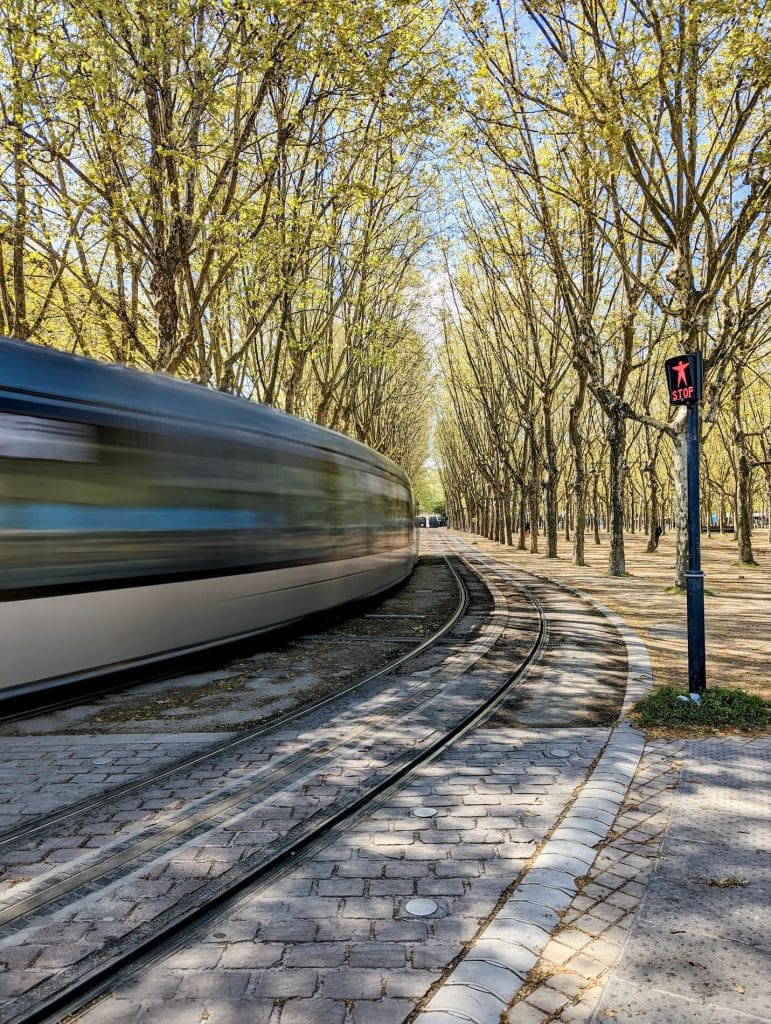
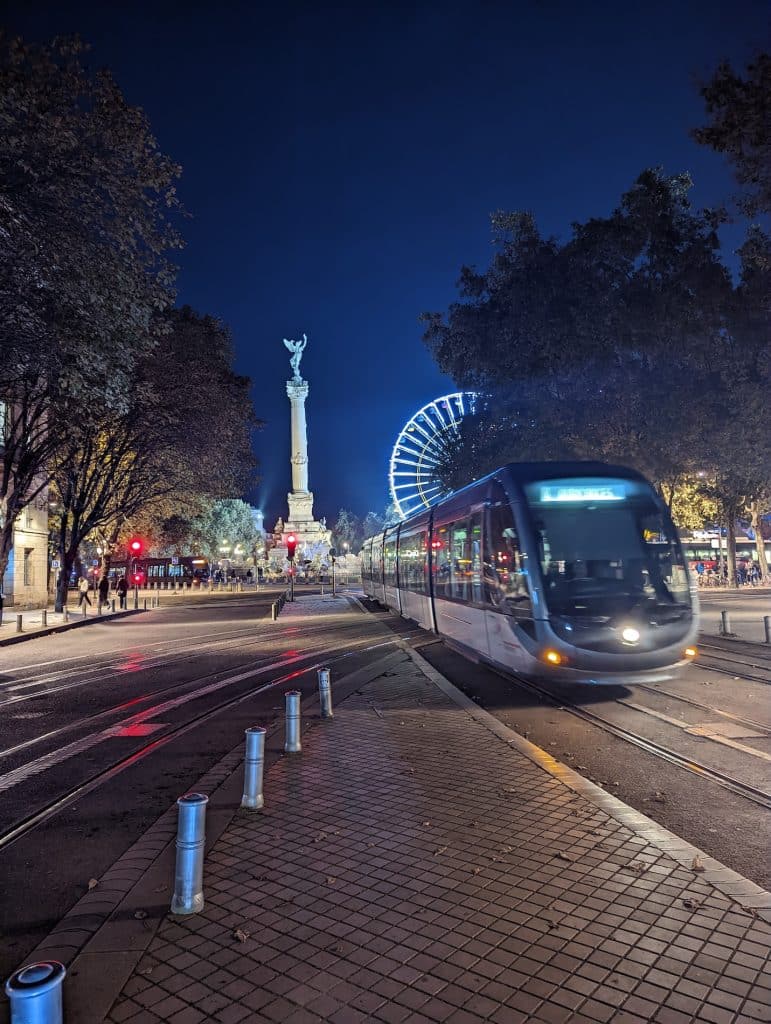
Tourists photograph place de la Bourse, the Grand Théâtre, Saint-André cathedral. They find the picture works without knowing why. The answer is simple: there is nothing in the sky. Not a cable, not a pole, none of those electric cobwebs that follow tramways everywhere else. In Bordeaux, the power runs along the ground, through a third rail set in the middle of the track. When the city switched it on, in December 2003, nobody in the world was operating such a system. Twenty years on, you find it in Dubai, Rio, Sydney and Istanbul. And the people of Bordeaux walk over it every day without a second thought.
A tram, yes, but without wires
Back to 1995. Alain Juppé succeeds Jacques Chaban-Delmas as mayor. The automatic metro project, which had been dragging on for years, is buried, and in 1997 the urban community adopts plans for a tramway instead. The last Bordeaux tram had bowed out on 7 December 1958: the city is about to pick up an old story where it left off.
One major problem remains. A modern tramway means an overhead contact line, which means cables strung six metres above the ground, poles, and stays bolted to the façades. In front of 18th-century buildings, on the Pont de pierre, at the foot of the cathedral, the idea goes down badly. Bordeaux wants the tram without the hardware. It demands a solution that does not yet exist: an invisible, ground-level power supply throughout the historic heart of the city.
An old idea, a new technology
Running the current along the ground is not a new idea. At the end of the 19th century, Lyon and Paris tested tramways powered by metal studs set along the centre of the track. These temperamental systems, sometimes dangerous for horses and passers-by, had all disappeared from France by around 1910. The overhead wire had won.
A century later, electronics change the game. A small company in Vitrolles, Innorail, a subsidiary of the Spie group, develops a process called APS, for alimentation par le sol, or ground-level power supply. A first trial takes place in Marseille in 1999, on 350 metres of track. That is all. When Bordeaux selects this technology for its future network, it has never carried a single passenger. The gamble is huge, and so is the extra cost: around 15 million euros for the first phase.
How it works, beneath your feet
Look at the track next time you are waiting at Hôtel de Ville or Place de la Bourse. Between the two running rails there is a third, flat and flush with the paving. This rail is not continuous. It is divided into conductive sections of 8 metres, separated by insulating sections of 3 metres. Under the roadway, every 22 metres, a control box runs the whole thing.
The whole trick lies here: a section is only powered, at 750 volts, when a tram covers it entirely. The tram signals its presence by radio through an antenna fitted under the body, the box powers the section, collector shoes pick up the current, and the section is switched off as soon as the tram has passed. At 44 metres long, a Bordeaux tram always hides the live sections under its floor. Ahead of it and behind it, the rail is just an inert piece of metal, crossed every day by thousands of pedestrians, bikes and pushchairs. And if a box fails, on-board batteries let the tram get past the obstacle.
21 December 2003: an eventful inauguration
The big day comes on 21 December 2003. Line A enters service between Mériadeck and the right bank, towards Lormont and Cenon. The President of the Republic, Jacques Chirac, has made the trip with his transport minister, Gilles de Robien. Alain Juppé gives the speech, and the crowds turn out despite the gloomy weather.
Then things go wrong. Because of technical problems, the President cannot board as planned at Hôtel de Ville station: he travels by car to Stalingrad, on the other side of the Pont de pierre, where he finally steps onto a tram. The day will see two incidents and a breakdown lasting two and a half hours. The technicians insist the third rail is not to blame and point to overloaded trams, victims of their own success. The people of Bordeaux mostly remember the image.
Two years of trouble, then the whole world
What follows gives the sceptics plenty to talk about. Lines B and C open in the spring of 2004, and for long months APS keeps playing up. Breakdowns remain frequent until the autumn of 2005, to the point that the urban community sets an ultimatum: fewer than 1% of failures before the end of the year. In the meantime, Alstom has taken over Innorail and overhauled the system from top to bottom. Reliability ends up above 99%, and in 2006 the wire-free tram wins an innovation award.
The following year, in 2007, the Port of the Moon joins the Unesco World Heritage list, its views intact. And Bordeaux's third rail starts to travel. Reims adopts it in 2011 to run past its cathedral, Angers the same year, then Orléans in 2012 and Tours in 2013. In 2014, Dubai opens the first line powered entirely from the ground. Then come Rio de Janeiro in 2016, just before the Olympic Games, Sydney in 2019, Cuenca in Ecuador, Istanbul in 2021, Lusail in Qatar in 2022 and Barcelona in 2024. A technology broken in between Pey-Berland and the Quinconces now runs on four continents.
The pantograph game
APS is expensive, far more so than an overhead line. Bordeaux has therefore kept it for the city centre. Elsewhere, the tram runs like every other tram in the world, with a pantograph raised to a wire. Between the two there is a moment regulars no longer even see. At a standstill, in a station, the articulated arm on the roof folds away like an insect tucking in its legs, or unfolds again, depending on the direction of travel. The tram moves off, and nobody has looked up from their phone.
This may be the invention's finest achievement: it was designed not to be seen, and it succeeds perfectly. The tram glides over the Pont de pierre without a single wire above the Garonne, runs along the water mirror, brushes past the Grand Théâtre, and postcards of Bordeaux still look like engravings. To follow the thread of this story, from the horses of 1880 to the disappearance of 1958, read our article The Bordeaux Tram: Bordeaux, was it better before?
Where to see the wire-free tram
Hôtel de Ville station: place Pey-Berland, 33000 Bordeaux (where lines A and B cross, third rail clearly visible)
Pont de pierre: crossing the Garonne with no overhead line at all (line A)
Place de la Bourse station: quai du Maréchal-Lyautey, 33000 Bordeaux (line C, facing the water mirror)
At the edges of the centre: watch in the stations for the pantograph rising or folding on the roof of the tram