
A historical investigation beneath the musée d'Aquitaine
In Bordeaux, there is a place where history literally rests beneath our feet. At the musée d'Aquitaine, behind the monumental cenotaph depicting Michel de Montaigne, hides a question that has intrigued historians and archaeologists for decades:
is the philosopher really buried there?
Michel Eyquem de Montaigne (1533-1592), author of the famous Essais, is also an important figure in the history of Bordeaux. He was mayor of Bordeaux between 1581 and 1585, in a period marked by the religious tensions of the Wars of Religion. When he died on 13 September 1592, at his château of Saint-Michel-de-Montaigne, his family decided that Bordeaux, the city he had administered, would also be his final resting place.
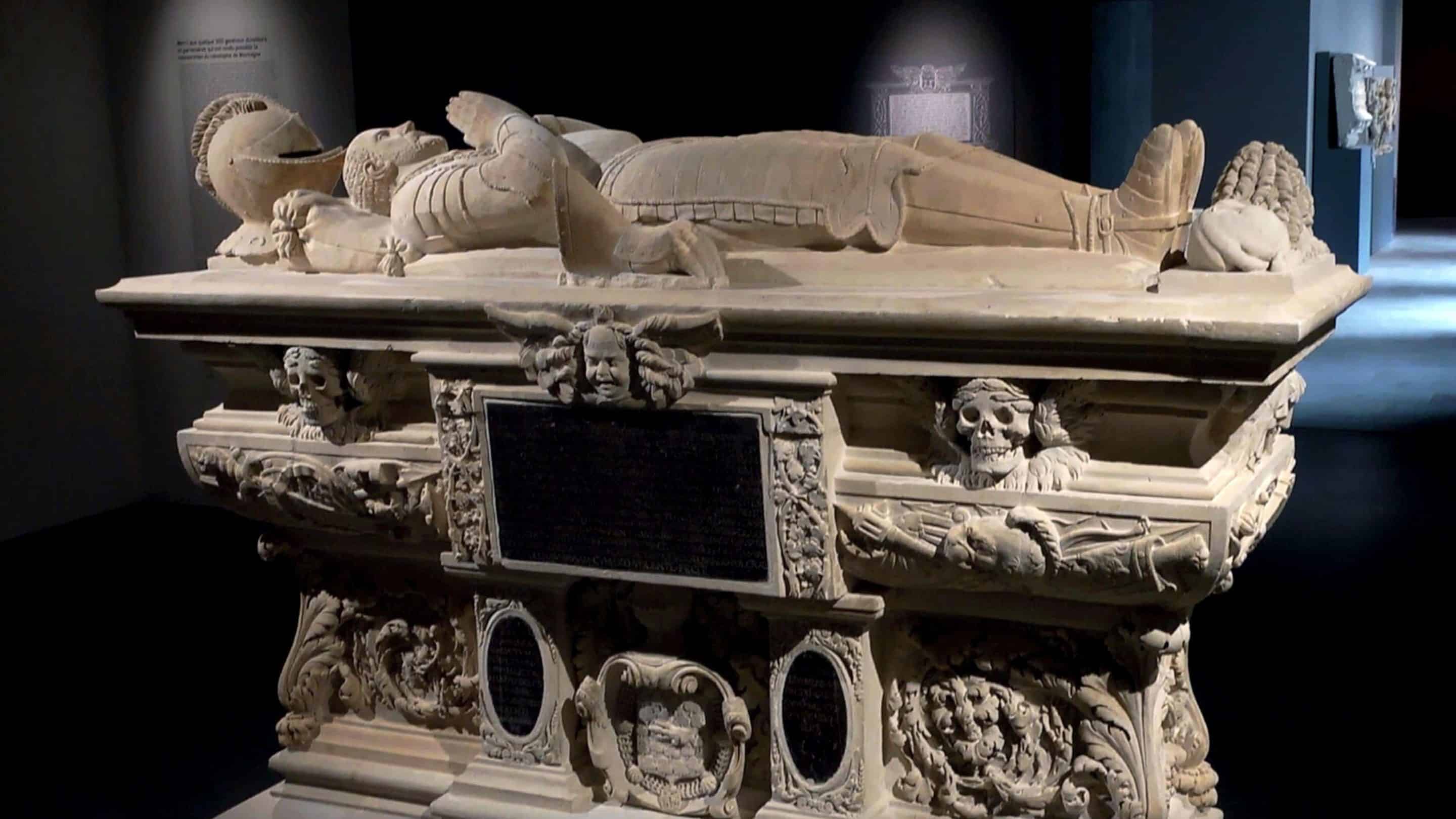
In 1593, his remains were moved to the Feuillants convent, on the site of today's musée d'Aquitaine. A funerary monument was commissioned: a cenotaph showing Montaigne lying in armour, with a lion at his feet, a traditional symbol of courage and nobility.
This monument still stands today and can be seen by museum visitors.
Remains moved and forgotten for centuries
The story of Montaigne's tomb becomes particularly tangled after the French Revolution. The Feuillants convent was destroyed and the graves were moved. The remains attributed to the philosopher were transferred several times over the following decades.
They were notably moved:
- from the Feuillants convent
- to a lycée built on the site
- then to the Chartreuse cemetery
- before finally being reinterred in the 19th century in a vault built beneath the Palais des Facultés, the future musée d'Aquitaine.
Over time, the exact location of the tomb was almost forgotten.
For more than a century, no one opened this vault.
Recent excavations revive the mystery
In 2018, the musée d'Aquitaine decided to check what actually remained in this presumed tomb. In the museum's basement, archaeologists discovered a coffin bearing the inscription « Michel de Montaigne ».
An archaeological excavation was launched in 2019.
Inside the wooden coffin was a lead sarcophagus, relatively well preserved, containing human remains. Initial analyses indicated that it was an adult male individual, consistent with the philosopher's profile.
However, researchers remain cautious. Specialists describe remains « very probably those of Montaigne », but a definitive identification requires further scientific analysis. In the meantime, the cenotaph keeps welcoming visitors in the museum's rooms.
And a few metres below, in the darkness of the basement, one fascinating question remains: Does Montaigne really rest beneath the musée d'Aquitaine?