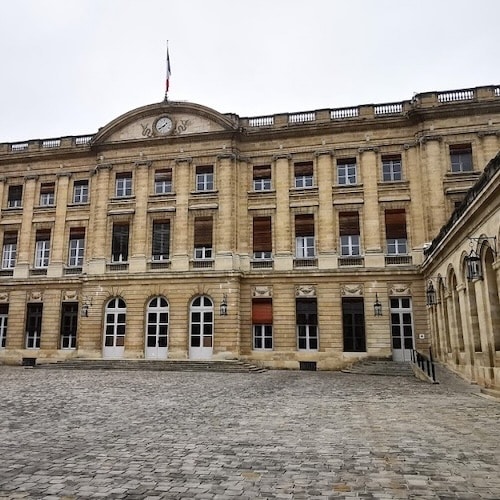

You walk past it every day, sometimes you look up at its clock, you may even cross its courtyard during the Heritage Open Days… Palais Rohan, our city hall for nearly two centuries, is one of the most photographed monuments in Bordeaux. But what you probably don't know is that beneath its cobblestones, its vaulted cellars and the honey-coloured stone of its façade sleeps a story few Bordelais have heard: the tale of a secret underground passage said to link the city hall to Saint-André cathedral, only a few dozen metres away.
An escape route? A service gallery between the archbishop and his cathedral? A simple urban legend nurtured by successive elected officials? We pulled on the thread, and the story is a lot juicier than it looks.
An archbishop's palace turned city hall: 250 years of intrigue
To understand this mystery, we first have to travel back in time. Palais Rohan has not always been the city hall. Far from it. Originally, it was commissioned in 1771 by Monseigneur Ferdinand-Maximilien-Mériadec de Rohan-Guéméné, freshly appointed Archbishop of Bordeaux and heir to one of the most powerful aristocratic families in France. The man had nerve: he wanted a residence worthy of his rank, and he was willing to put the means to match.
The works ran from 1771 to 1784, first entrusted to architect Joseph Étienne then completed by Richard-François Bonfin. Total cost: more than 2 million livres, roughly the equivalent of 22 million euros today. A pharaonic project for an episcopal residence, only a few steps from Saint-André cathedral, where the archbishop was of course the master.
And this is where the story gets interesting. Because between the palace and the cathedral, you only have a few dozen metres to cover… in the open. Yet in the late 18th century, the open air was not always the safest place for a prelate of the high nobility.
Then came the Revolution, and the palace changed hands at a frantic pace:
- 1791: the palace became the seat of the revolutionary tribunal and the department's general council.
- 1800: it housed the prefectural administration under prefect Antoine Claire Thibaudeau.
- 1808: Napoleon I turned it into his imperial palace during his visits to Bordeaux.
- 1815: Louis XVIII used it as a royal palace after the Restoration.
- 1836: mayor Joseph-Thomas Brun moved the Bordeaux city hall in permanently.
One detail that matters for what follows: on 13 June 1862, a devastating fire ripped through part of the building. The municipal archives went up in smoke, and with them, perhaps, the precise plans of any underground passages built under the Ancien Régime. Convenient, for a legend.
The famous passage to Saint-André: between accounts, renovations and grey areas
Let's get to the heart of the mystery. According to several accounts collected over the decades, an underground passage really does link Palais Rohan to Saint-André cathedral. Its supposed function? To give the archbishop a discreet and protected route to his cathedral, and more importantly, to serve as an escape route in case of attack. In an era when popular riots and religious tensions were far from empty threats, the idea is anything but far-fetched.
The problem is that today, this tunnel is sealed off. The rare people who have caught a glimpse of its remains are mostly municipal agents and workers involved in renovation projects. The accounts going around speak of:
- a stone vaulted gallery, fairly narrow, starting from the basements of the palace's north wing,
- sections walled up over the centuries as a precaution,
- stretches never fully explored, not even by the city's technical services.
Today, the city hall confirms the existence of a network of underground galleries beneath Palais Rohan, but flatly refuses to open access to the public, officially for safety reasons. Stability of the vaults, risks of collapse, but also (so it is whispered) security concerns for a building that remains, above all, the seat of municipal power.
So, myth or reality? Let's say it is a bit of both. The underground passage exists, that much is almost certain. Its exact layout, its route towards Saint-André, its real condition today: all of that still belongs to the realm of hypothesis and oral tradition. The archives destroyed in 1862 did not help, and the city does not seem in a hurry to commission an official archaeological study that would settle the matter.
What is certain is that Bordeaux is no stranger to mysterious underground networks: between the Frontenac quarries, the Saint-Seurin crypt, the medieval sewers and the historic wine cellars of the city centre, the city hides beneath its cobblestones a real second Bordeaux, silent and forgotten. The Palais Rohan tunnel is probably its most emblematic chapter… because it is the most inaccessible.
Next time you cross Place Pey-Berland, between the city hall and the cathedral, look at the cobbles under your feet a little differently. A few metres below, a stone gallery may have been waiting for 250 years for someone to finally unlock its last secret.