
Lire cet article en français : 150 rues effacées à Bordeaux.
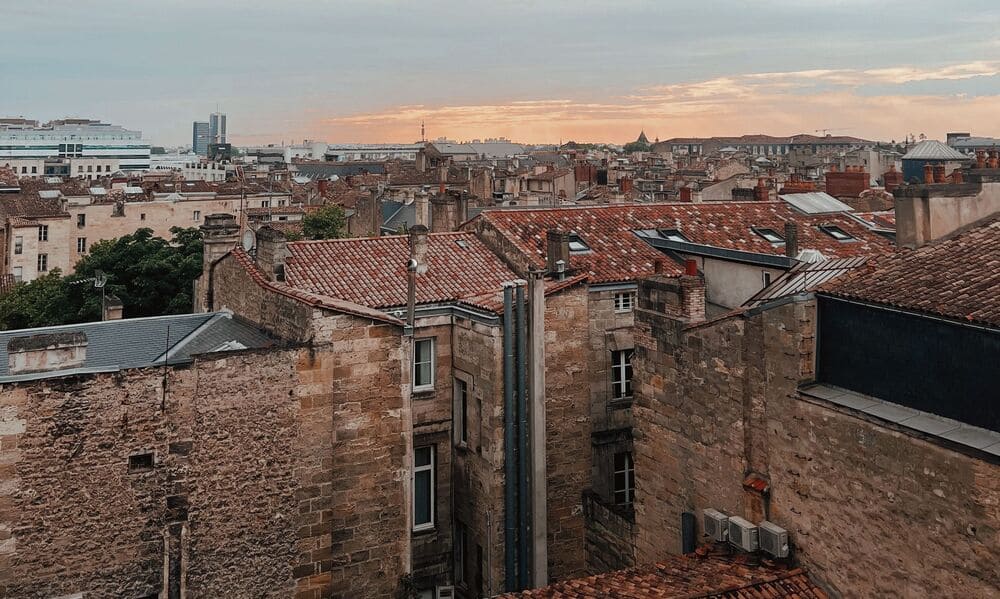
In Bordeaux, a vanished street is not always a street that was simply renamed. Some were fully wiped out by major public works, others swallowed by a square, an avenue or a haussmannian block. An inventory devoted to Old Bordeaux lists around 150 of them. They are not entirely dead, though: their outline still shows through, their name resurfaces under a plaque, and sometimes an inscription engraved in the stone betrays what stood there before. A short inventory of the Bordeaux you don't see anymore, and a map to go hunting for its traces.
Why they disappeared
Three major urban episodes account for most of the erased streets in Bordeaux. Three moments when the city decided to rewrite itself, even if that meant razing entire neighbourhoods.
The Château Trompette and the Quinconces
Before today's place des Quinconces, the area formed a small suburb called Troupeyta, later Trompette. The construction of the Château Trompette, starting in 1453, turned this neighbourhood upside down, pressed as it was against the ramparts and the Garonne. Later, the demolition of the fortress made way for the Quinconces esplanade, Europe's largest square, at the cost of several old streets that were swept away.
Today, almost nothing of that urban fabric remains. Some names only appear on 18th century plans or in the municipal archives.
Place de la Bourse and place du Parlement
The creation of the great classical squares replaced narrower, more irregular medieval streets. The Bourse and Parlement area was deeply reshaped to open up monumental perspectives facing the river. This is the typical transformation of 18th century Bordeaux: old blocks are torn down to build a more open city, more prestigious, better fitted for port trade.
The cutting of cours Alsace-Lorraine
At the end of the 19th century, the cutting of cours Alsace-Lorraine wiped out several houses, alleys and portions of streets. This avenue notably replaced part of the old neighbourhood close to the Peugue, a stream now largely covered over in the city centre. Rue du Pont-Saint-Jean is one of the streets removed during these works. Old houses and fragments of rue Ausone were also affected.
A few streets that still haunt the archives
Some left behind stories, others only a single line in an old registry. A short pick of the most surprising ones.
Rue de Galles, in the old Mériadeck district, disappeared under the buildings and concrete of the modern quarter built in the 1970s. It was known for its venues frequented by German soldiers and non-commissioned officers during the Occupation. A not-so-glorious slice of Bordeaux's memory, physically erased by the construction of the new Mériadeck.
Rue de la Comédie stood in the Château Trompette area. It disappeared with the successive transformations of the district. Its name recalls the importance of shows and theatres in this corner of Bordeaux before the Grand Théâtre opened in 1780.
Rue de Mos, mentioned in medieval documents, is thought to have been torn down as early as 1451. It bears witness to a Bordeaux whose streets often carried the names of families, trades or places now forgotten.
Rue de la Chapelle-Saint-Martin ran close to the archbishop's palace. Like many old streets, it was removed or absorbed by 19th century urban schemes.
Rue de Sarlat, which later became rue Montaigne then impasse Fauré, illustrates another case: the street did not fully vanish, but its route and its name changed several times over the centuries. A street with three lives.
The clues still visible in the stone
The best part is that some streets are not fully erased. In the historic centre, you can sometimes spot an old inscription carved into the stone under a more recent plaque. These traces show up especially around Saint-André and in the old neighbourhoods close to the cathedral.
The reflex to have: look up at first-floor level, where the old plaques were sealed. Some were covered over, others simply doubled up. A slanted light at the end of the afternoon is sometimes enough to bring the engraved letters back out. This is the urban archaeology method, the one architect Michel Pétuaud-Létang systematised in his research on Old Bordeaux.
Another clue: the shape of the blocks. When a small alley has been removed, the line between two buildings often still betrays its passage, through a setback in the façade, a blind gable, or a difference in height or period between two constructions glued to one another.
A walk to go hunting for their traces
The best way to feel this submerged Bordeaux is to walk. Here is a tested route, five stops, about an hour and a half at a relaxed pace.
1. Start from Saint-André cathedral and the archbishop's palace area. That is where the traces are most numerous, doubled plaques and narrowed alleys included.
2. Head down towards rue Sainte-Catherine and place du Parlement. Look at the geometry of the square: it swallowed entire blocks.
3. Cross cours Alsace-Lorraine, searching for the old block edges in the façades that line the avenue.
4. Reach the Quinconces to imagine the former Château Trompette neighbourhood. Today all that remains is the vast esplanade, but old plans reveal a dense tangle of streets.
5. End at Mériadeck, where the disappearance of rue de Galles illustrates the massive 20th century urban upheavals. The contrast between the concrete slab and the carvings you just looked at around the cathedral says a lot.
To dig deeper
The reference book: Les rues disparues du Vieux Bordeaux, by Michel Colle and Michel Pétuaud-Létang, described as a genuine work of urban archaeology
Press sources: Sud Ouest, tribute to the 150 streets that are no more and architect Michel Pétuaud-Létang on Bordeaux's vanished streets
Dedicated blog: Rues de Bordeaux, a volunteer, thorough inventory
Where to see old maps: Archives municipales de Bordeaux, quai Wilson
Lire cet article en français : 150 rues effacées à Bordeaux.